Buying a Long Put: A Primer to Bearish Options Trading
🔍 What Is a Long Put?
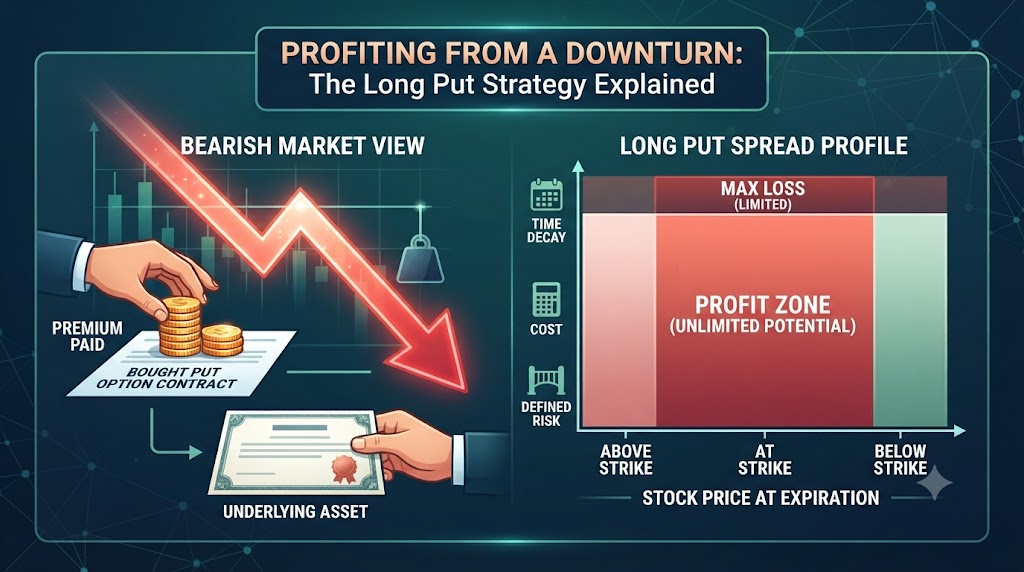
A long put is an options strategy where you buy a put option because you expect the price of the underlying stock, ETF, or index to fall.
When you purchase a put, you acquire the right, but not the obligation, to sell the underlying asset at a specific price (the strike price) anytime before the option expires. Each contract controls 100 shares.
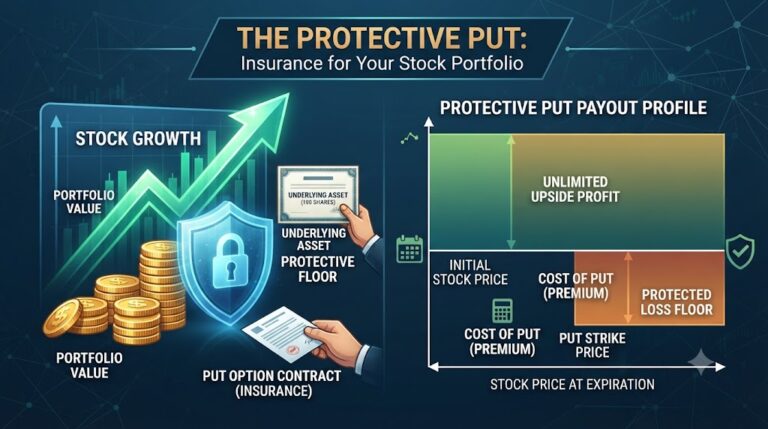
Think of it like an insurance policy: You pay a premium upfront. If your “house” (the stock) loses value, the insurance pays out. If the house doesn’t lose value, you simply let the insurance lapse and only lose the premium you paid.
📊 The Upside and Downside
This strategy is the opposite of a long call, and its risk/reward profile is defined:
- Profit Potential: Your profit grows as the stock drops. While a stock can only fall to $0, your potential profit is capped at the strike price minus the premium you paid. (Unlike a long call, it isn’t “infinite,” but it can be a high return if the stock fall is steep.
- Limited Risk: Your maximum loss is strictly limited to the premium you paid for the option (plus commissions and fees). If the stock stays above the strike price, the option expires worthless, and you lose only what you paid for it.
📈 A Real Example
Let’s walk through a practical example to make this concrete:
Suppose a stock is currently trading at $100 per share. You believe the company is going to report bad earnings and drop. You decide to buy a $95 strike put for a $3 premium (which costs $300 total, as one contract covers 100 shares).
- Breakeven Price at Expiration: $92 ($95 strike – $3 premium). The stock must drop below $92 for you to make a net profit.
- Maximum Loss: $300 (the premium paid). This happens if the stock stays above $95.
Scenario A (The stock crashes to $80):
- You have the right to sell shares at $95, even though they are only worth $80 in the market.
- Your intrinsic gain is $15 per share ($1,500).
- After subtracting your $300 premium, your net profit is $1,200.
Scenario B (The stock stays flat or rises to $105):
- The put option expires worthless.
- Your maximum loss is the $300 premium you paid. You do not lose money on the underlying stock because you never bought the stock—you just bought the option.
✅ Why Use a Long Put Strategy?
- Hedging (Portfolio Insurance): This is the most common professional use. If you own 1,000 shares of a stock and are worried about a short-term dip but don’t want to sell your position (due to tax reasons or a long-term thesis), you can buy puts as insurance. If the stock drops, your stock loses value, but your puts gain value, offsetting the loss.
- Speculating with Limited Risk: You can profit from a stock’s decline without the unlimited risk of short-selling the stock. (If you short-sell a stock at $100 and it goes to $150, your loss is higher. With a long put, your loss is capped at the premium).
- Leverage: You control 100 shares of stock for a fraction of the cost of shorting it outright.
⚠️ The Trade-Offs and Risks
Just like a long call, the long put has a mortal enemy: Time.
- Time Decay (Theta): Options lose value as they get closer to expiration. If the stock takes too long to drop, time decay will eat away at the value of your put, even if the stock is moving slightly lower.
- Volatility Drops (Vega): Puts benefit from high market fear (volatility). If the market calms down and the VIX drops, your put will lose value, even if the stock stays flat.
- It’s a Wasting Asset: If the stock doesn’t drop below your strike by expiration, your entire investment goes to $0. You cannot roll it over for free; you must pay a new premium.
🆚 Long Put vs. Short Selling a Stock
Many new investors confuse these two. Here is the critical difference:
| Feature | Long Put | Short Selling the Stock |
| Max Loss | Limited to the premium paid | Unlimited (stock can theoretically rise forever) |
| Max Profit | Capped (Stock can only fall to $0) | Capped (Stock can only fall to $0) |
| Cost to Enter | Low (only the premium) | High (must put up margin collateral) |
| Time Constraint | Yes—must be right within the timeframe | No—you can hold the short indefinitely (as long as you pay borrow fees) |
| Stress Level | Low (defined risk) | High (margin calls and unlimited risk) |
💡 Pro Tips for Trading Long Puts
- Use Them for Catastrophe Insurance: Instead of buying expensive, deep-in-the-money puts, consider buying “Out-of-The-Money” (OTM) puts that are cheaper. These act like disaster insurance—you won’t profit from a 5% dip, but if the market crashes 15%+, your cheap puts will explode in value.
- Don’t Fight the Trend: A long put is a directional bet. Only use this strategy when a stock has clear technical breakdowns or bearish fundamentals. Buying puts on a strongly uptrending stock is a quick way to lose your premium.
- Take Profits Early: If the stock drops sharply and your put doubles in value in two days, consider closing the trade. The remaining time decay might erode those gains quickly, and locking in a 100% profit is rarely a bad decision.
- Mind the Expiration: Give yourself enough time. If you are buying puts for a specific event (like an earnings report), buy an expiration that gives you at least 2–3 weeks after the event. This protects you if the stock doesn’t drop immediately on the news.
🧠 The Bottom Line
The long put is a powerful, straightforward tool. It is a “defined risk” bearish play. Whether you are using it to hedge a stock portfolio against a market correction, or you are purely speculating that a specific stock is overvalued, the long put ensures you can sleep at night knowing your maximum loss is written in stone the moment you place the trade.
To provide high-quality insights, this article was partially or fully written with the assistance of AI technology and reviewed by human contributor.