Buying a Long Call: A Primer to Bullish Options Trading
Buying a Long Call: A Beginner’s Guide to Bullish Options Trading
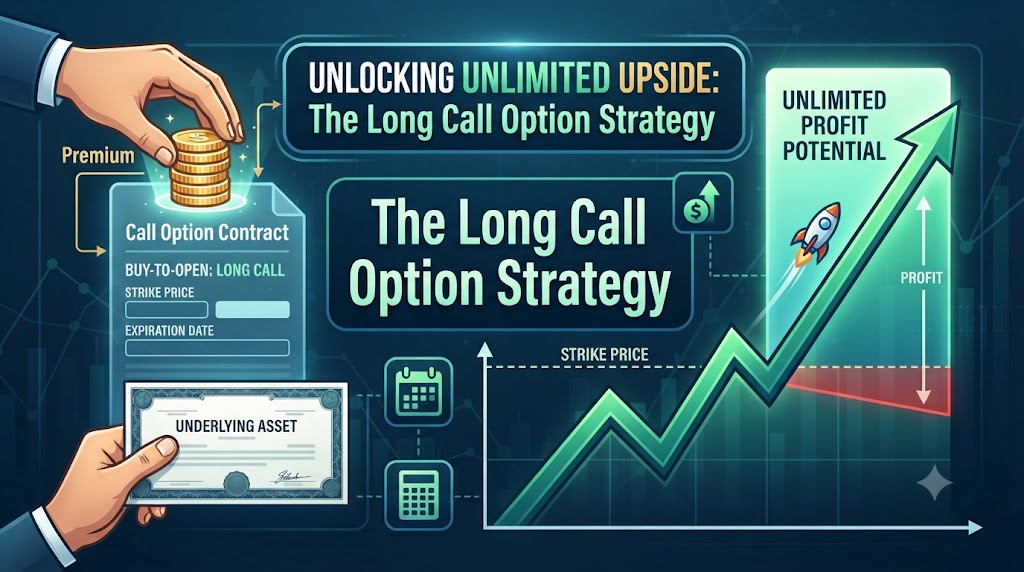
If you’re bullish on a stock but don’t want to commit the capital to buy 100 shares outright, a long call option might be a strategy you can use. It lets you profit from a stock’s rise while limiting your risk to just the premium you pay—no more, no less.
What Is a Long Call?
A long call is simply an options strategy where you buy a call option because you expect the price of the underlying stock, ETF, or index to rise. The word “long” means you are the buyer of the option.
When you purchase a call, you acquire the right, but not the obligation, to buy the underlying asset at a specific price (the strike price) anytime before the option expires. Each options contract typically controls 100 shares of the underlying stock.
The Upside and Downside
Here’s what makes the long call strategy attractive—and where the risks lie:
- Unlimited Profit Potential: Your profit is theoretically unlimited because there’s no cap on how high the underlying stock price can rise by your contract’s expiry date.
- Limited Risk: Your maximum loss is limited to the premium you paid for the option (plus any commissions and fees). If the stock stays below the strike price, the option expires worthless, and you lose only what you paid.
A Real Example
Let’s walk through a practical example to make this concrete:
Suppose a stock is trading at $55 per share. You believe the price will rise, so you buy a $60 strike call option for a $2 premium (which costs $200 since one contract covers 100 shares).
Your breakeven price at expiration is $62 ($60 strike + $2 premium). This is the price the stock must exceed for you to make a profit.
Scenario A: The stock rises to $80
- Exercising lets you buy shares at $60 – a $20 per-share gain, or $2,000.
- After subtracting your $200 premium, your net profit would be $1,800.
- Remember: You don’t have to exercise the option. Many traders simply sell the option contract itself for a profit as the stock price rises, avoiding the need to buy shares altogether.
Scenario B: The stock stays below $60
- The option expires worthless.
- Your maximum loss is the $200 premium you paid.
Benefits of Long Calls
Why choose this strategy over simply buying the stock?
- Leverage: You control 100 shares for a fraction of the cost of buying them outright.
- Defined Risk: Unlike owning stock that could drop to zero, your loss is capped at the premium paid.
Key Disadvantages to Consider
Before jumping in, understand these drawbacks:
- Time Decay: Options lose value as expiration approaches. If the stock doesn’t move in your favor quickly enough, time decay can eat away at your position’s value.
- Expiration Risk: If the stock fails to rise above the strike price by expiration, your option becomes worthless.
- Volatility Changes: The value of your option is sensitive to “implied volatility.” If the market’s expectation of price fluctuations decreases, the option’s value can drop even if the stock price remains stable.
- No Dividends or Voting Rights: As an option holder, you don’t receive dividends or voting rights that come with owning the actual stock.
Who Should Use This Strategy?
Long calls are best suited for:
- Speculators expecting a short-term price rise.
- Investors who want bullish exposure with limited risk.
- Those looking to avoid tying up significant capital to own shares outright.
To provide high-quality insights, this article was partially or fully written with the assistance of AI technology and reviewed by human contributor.