Bull Call Spread Strategy
🔍 What Is a Bull Call Spread?
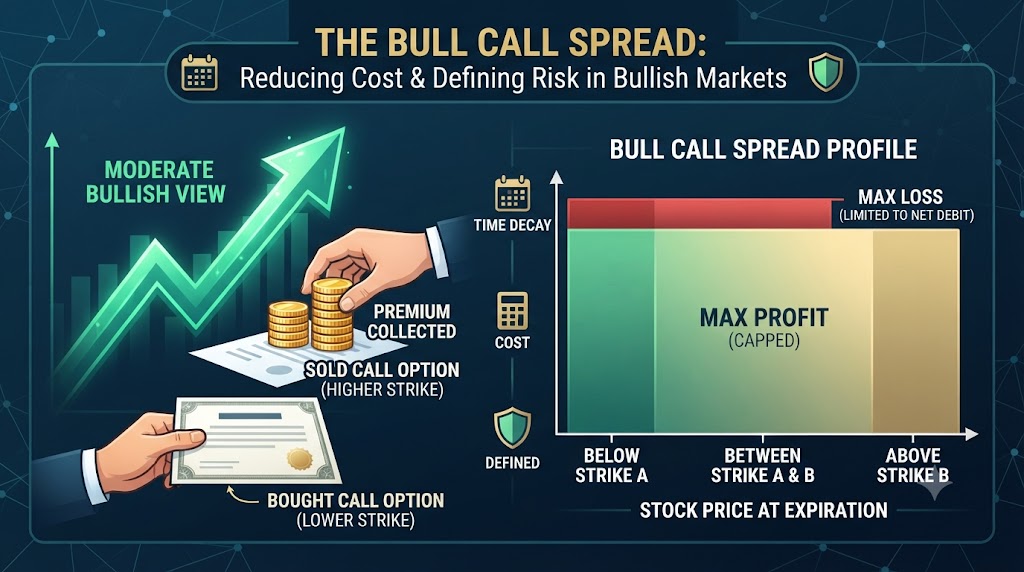
A bull call spread (also called a “vertical bull call spread” or “debit call spread”) is a moderately bullish options strategy used when you expect the price of an asset to rise, but you want to reduce the cost and risk associated with buying a standard long call.
It involves two transactions on the same stock, simultaneously buying one call option and selling another call option with a higher strike price, both with the same expiration date.
- You buy a call option at a lower strike price (this is your “long” leg).
- You sell a call option at a higher strike price (this is your “short” leg).
By selling the higher-strike call, you collect a premium that offsets the cost of buying the lower-strike call. This reduces your net out-of-pocket cost significantly. However, in exchange for that cheaper entry price, you agree to cap your upside at the higher strike price.
📊 How It Works (Step-by-Step Example)
Let’s say Stock XYZ is currently trading at $100. You are bullish and think it will rise, but you aren’t sure it will skyrocket.
- Buy the $105 strike call for **$4.00** ($400 total).
- Sell the $115 strike call for **$1.50** ($150 total).
- Net Cost (Max Risk): $4.00 – $1.50 = **$2.50** ($250 total).
Here is your financial picture for this trade:
- Maximum Risk (Loss): The net premium you paid, which is **$2.50** ($250). You lose this if the stock is below $105 at expiration.
- Maximum Profit: The difference between the strikes minus the net premium you paid. Calculation: ($115 – $105) – $2.50 = **$7.50** ($750 per contract).
- Breakeven Point: Lower strike price + net premium paid. Calculation: $105 + $2.50 = $107.50. The stock must close above this price for you to make a profit.
📈 The Two Scenarios at Expiration
Here is exactly what happens when the options expire:
- Scenario A (Bearish): Stock closes at $102.**
Both options expire worthless. You lose your entire **$250 net investment. - **Scenario B (Moderately Bullish): Stock closes at $112.**
Your $105 call is worth $7.00 ($700). Your $115 call is worthless. After subtracting your original $250 cost, your profit is $450. - **Scenario C (Very Bullish): Stock closes at $130.**
Your $105 call is worth $25. Your $115 call is worth $15. You are obligated to sell at $115, but you bought at $105, so your intrinsic gain is $10 ($1,000). After subtracting your $250 cost, your max profit is **$750**. Even if the stock goes to $200, you still only make $750.
✅ Why Use a Bull Call Spread?
- Cheaper Entry: The premium collected from the sold call lowers the total capital required compared to a standalone long call. In our example, a straight $105 call cost $400, but the spread only cost $250.
- Reduced Breakeven: Because your net cost is lower, the stock doesn’t have to rise as much for you to turn a profit compared to just buying the lower strike call outright.
- Less Time-Decay Pain: The short call you sold helps offset the “theta decay” (time erosion) that hurts long options. If the stock drifts sideways, your losses accumulate slower than a standard long call.
⚠️ The Trade-Offs and Risks
- Capped Upside: This is the biggest drawback. If the stock explodes upward, you cannot make any money beyond the higher strike price. You sold away that upside potential.
- Max Loss is Still 100%: While your dollar loss is smaller than a long call, you can still lose 100% of your net investment if the stock doesn’t move.
- Early Assignment Risk (Rare but Real): If the stock pays a large dividend, the buyer of the call you sold (the $115 strike) might exercise early, complicating your position.
🆚 Bull Call Spread vs. A Standard Long Call
| Feature | Long Call | Bull Call Spread |
| Cost | High (pays full premium) | Low (premium is offset by selling) |
| Max Loss | Full premium paid | Full net premium paid (smaller) |
| Max Profit | Theoretically unlimited | Strictly capped |
| Breakeven | Higher (Strike + Premium) | Lower (Strike + Net Premium) |
| Best For | Strong, explosive upward moves | Steady, moderate upward moves |
💡 Pro Tips for Trading Bull Call Spreads
- Choose Strike Widths Wisely: Wider spreads (e.g., $10 apart vs. $5 apart) cost more but offer higher max profits. Narrower spreads are cheaper but have tighter profit caps.
- Mind the Expiration: Give yourself enough time. If you buy a spread that expires in a week, the stock needs to move fast. A 30-to-60-day expiration is a sweet spot for many traders.
- Exit Early: You don’t have to hold until expiration. If the stock hits your target profit early (say, you make 50% of the max profit in a week), consider closing the trade to lock in gains and remove the risk of a reversal.
🧠 The Bottom Line
A bull call spread is a fantastic strategy when you are confident a stock will go up, but you aren’t convinced it will double or triple. It lowers your financial risk, lowers your breakeven point, and gives you a highly defined risk/reward ratio. You are essentially trading away the “dream” of a massive moonshot for a much higher probability of making a steady, solid profit.
To provide high-quality insights, this article was partially or fully written with the assistance of AI technology and reviewed by human contributor.