Covered Calls Options Strategy
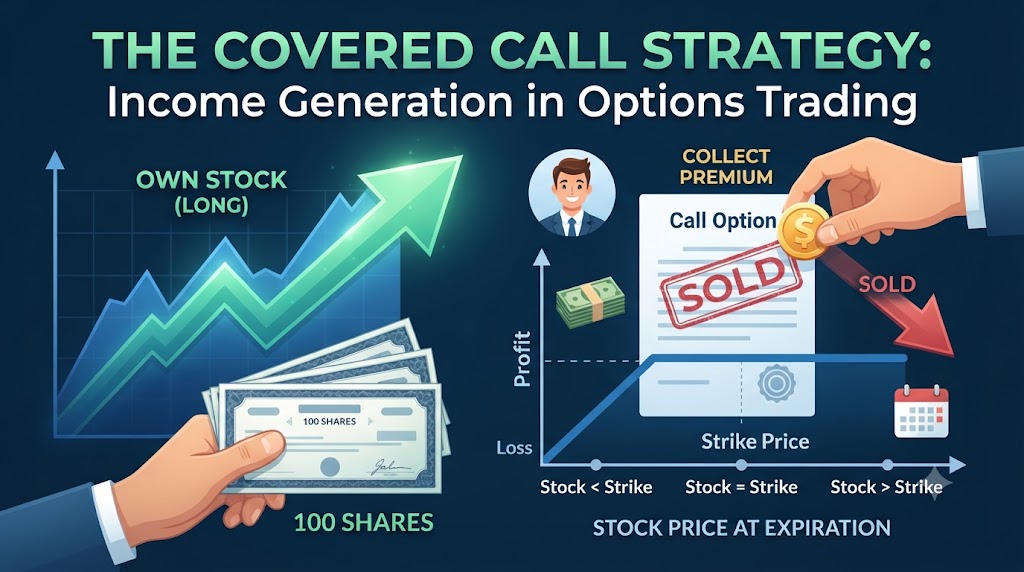
A covered call is an options strategy where you sell (write) call options on a stock you already own, generating income in exchange for capping your upside potential. The strategy is often used to generate additional income from a stock position or to set an exit price for selling shares.
🔍 How a Covered Call Works
When you sell a call option, you receive an upfront premium from the buyer. In return, you are obligated to sell your 100 shares per contract at the option’s strike price if the stock price rises above that level by the expiration date.
You receive income (the premium) immediately, and if the stock price stays below the strike price, you keep both the premium and your shares. If the stock rises above the strike price, your shares are “called away” (sold) at the strike price, and you keep the premium. Your profit is capped at the strike price plus the premium received.
📊 Profit, Loss, and Key Calculations
A covered call creates a specific risk/reward profile. Here are the key figures using an example where a stock is bought at $50 and a call option with a $55 strike price is sold for a $2 premium:
- Breakeven Point: $48 per share (initial price of $50 – premium of $2). This is the point where the trade neither makes nor loses money.
- Maximum Profit: Capped at the strike price. The maximum gain is $7 per share (($55 – $50) + $2 premium).
- Maximum Loss: The stock can fall to zero. The maximum loss is the stock’s cost minus the premium received (e.g., $50 – $2 = $48 per share).
📈 When to Use a Covered Call
This strategy is not for every situation. It works best under specific market conditions.
- Neutral to Mildly Bullish Outlook: When you expect the stock price to stay flat or rise only slightly. You keep the premium and your shares in a flat market.
- Income Generation: To boost returns from a stock that doesn’t pay a high dividend or is trading sideways.
- Exiting a Position: If you want to sell your shares at a specific target price, a covered call lets you collect a premium while waiting for the stock to reach that price.
- Lower Basis: The premium received reduces your total cost basis in the stock.
⚠️ Key Risks to Consider
While often considered a lower-risk option strategy, covered calls have important drawbacks.
- Capped Upside: You forfeit all potential profit beyond the strike price. If the stock price skyrockets, you miss out on those gains.
- Downside Risk: You are still fully exposed to the risk of the stock price dropping.
- Limited Downside Protection: The premium offers a small buffer, but it won’t fully protect you if the stock price drops significantly.
- Early Assignment & Tax Risk: The option buyer can exercise their right early, especially before an ex-dividend date, forcing you to sell shares sooner than expected. Selling a successful covered call can also create a taxable event if shares are called away.
💡 Practical Variations
Beyond individual stocks, you can gain exposure to this strategy through covered call ETFs. These funds sell call options on a basket of stocks (like the S&P 500) and can offer higher yields than traditional dividend funds. However, they also have higher fees and may pay some distributions as a “return of capital,” which is effectively giving you back your own money.
Some strategies also use a partial coverage ratio (selling options on only a portion of the holdings) to preserve more upside participation, as opposed to a full coverage strategy.
To provide high-quality insights, this article was partially or fully written with the assistance of AI technology and reviewed by human contributor.